A BRIEF MINI COOPER HISTORY
1959 The Beginning of Greatness
The Mini began its public life on the 26 August 1959. Its designer, Sir Alec Issigonis could not have even dreamed of the impact his little car would have on world culture, society and of course automobiles. The Mini was designed simply to be an affordable car which could seat four adults and still be small enough to travel in safely. Originally powered by 850cc 34bhp engine, this was the Mini in its purest form, simple, clean and agile.
1960-1969 The Evolution
Although the Mini saw through six decades it is always the 1960s for which it will be remembered for. These ten years saw the Mini go from a 'housewives shopping car' to the must have fashion accessory, via international stardom on the rally scene. It took John Cooper, twice F1 World Champion Constructor, to realize the full potential of the Minis sharp handling and maneuverability. In 1961 the first Mini Cooper hit the streets, firstly with a 997cc engine producing a massive 55bhp, there followed a range of engines for the Cooper from the rare 970cc Cooper S to the ultimate evolution the 76bhp 1275cc S, the car which would form the basis for the Works Rally car. The Cooper S achieved superstar status when the 91bhp Works spec cars won the Monte Carlo Rally outright for 4 years running from 1964-1967
(although the Minis were disqualified from the 1966 rally for having faulty headlamps!)
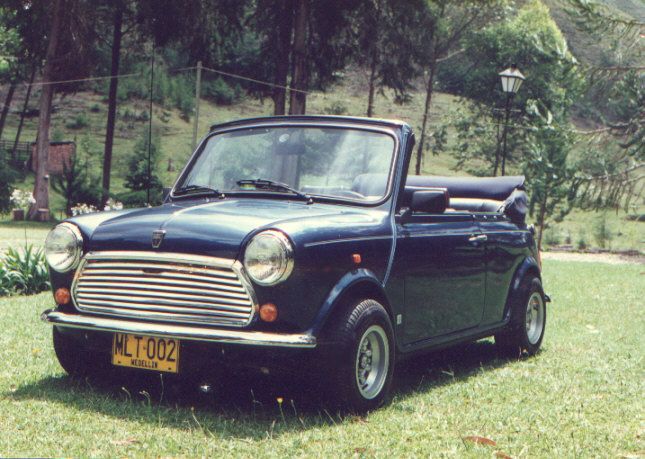
Now that the Mini had proven itself in front of a world audience, everybody wanted a Cooper, and indeed everybody who was anybody in the 60s had a Cooper, from The Beatles and Peter Sellers to Graham Hill and Enzo Ferrari! Of course they couldn't have any old Cooper they had to be modified. Companies such as Radford and Wood & Pickett who made their name tailor making Rolls Royce's and Bentleys now were turning their hands to Minis, with everything from electric windows and leather seats, to wickerwork sides and hatch backs. Thus a trend was started which has been kept p to this day, meaning that it's near impossible to find a Mini which hasn't been modified in some way.
1970-1979 The Clubman, need we say more?
The 1970s is often seen as the dark era of the Mini, various attempts were made to kill it off, starting with the end of the Cooper in 1971 to the launch of the Metro. But still the Mini soldiered on, with just enough people buying it in order to keep it alive. The launch of the Mini Clubman in the late 60s gave the Mini a much modernized feel, and although the design is a case of love it or hate it, it added a bit of variety to a rather dull 70s Mini line up. The Clubman is differentiated by the hotdog grill with lights inside the "dog".
1980-1989 The Question Years
By the 1980s the Mini was starting to die, and in a desperate attempt by new owners, Rover to keep it's head above water an alarming number of themed special editions were launched, over 40 different editions were produced between 1980 and 2000. The most successful of which was the Anniversary editions, an idea which started with the 1100 Special back in 1979, produced to celebrate 20 years of Mini production. The 80s saw the Mini 25 and 30 birthday editions, which were undoubtedly integral to the survival of the Mini for so long.

1990-2000 Rebirth, Death or Evolution? You Decide
The re-launch of the Cooper in 1990 brought about a much needed revival of interest in the Mini, particularly in Japan.The 90's Cooper initially had a 63bhp 1275cc carb engine, then in 1991 had an injection version of the same engine.Perhaps the biggest change in the Mini came about in 1997 with the introduction of the twin-point injection engine with a front mounted radiator, this engine was introduced as standard in both the Mini and Cooper models along with safety
features such as airbag and side impact bars in the doors. Along with this modernization came the 'Sportspack' option which included 13in alloy wheels, large wheel arches. The final Mini rolled off the production line on the 6th October 2000.
2001 And Beyond
The launch of the New MINI produced by BMW in 2001 adds perhaps not a new chapter, rather a whole new book to the Mini story. The new MINI currently comes in three models, the standard MINI One with a 1.6 liter 90bhp Chrysler engine, the Cooper powered by a 115bhp version of the same engine and the Copper S adding a supercharger. First impressions are good, the styling is mini-esque Mini, although the size is not quite so, nevertheless it drives almost as well
as the original in terms of enjoyment, but is far better for long distance cruising. Overall while the New MINI is a far cry from Issigonis' original design, in my opinion it is a great car.